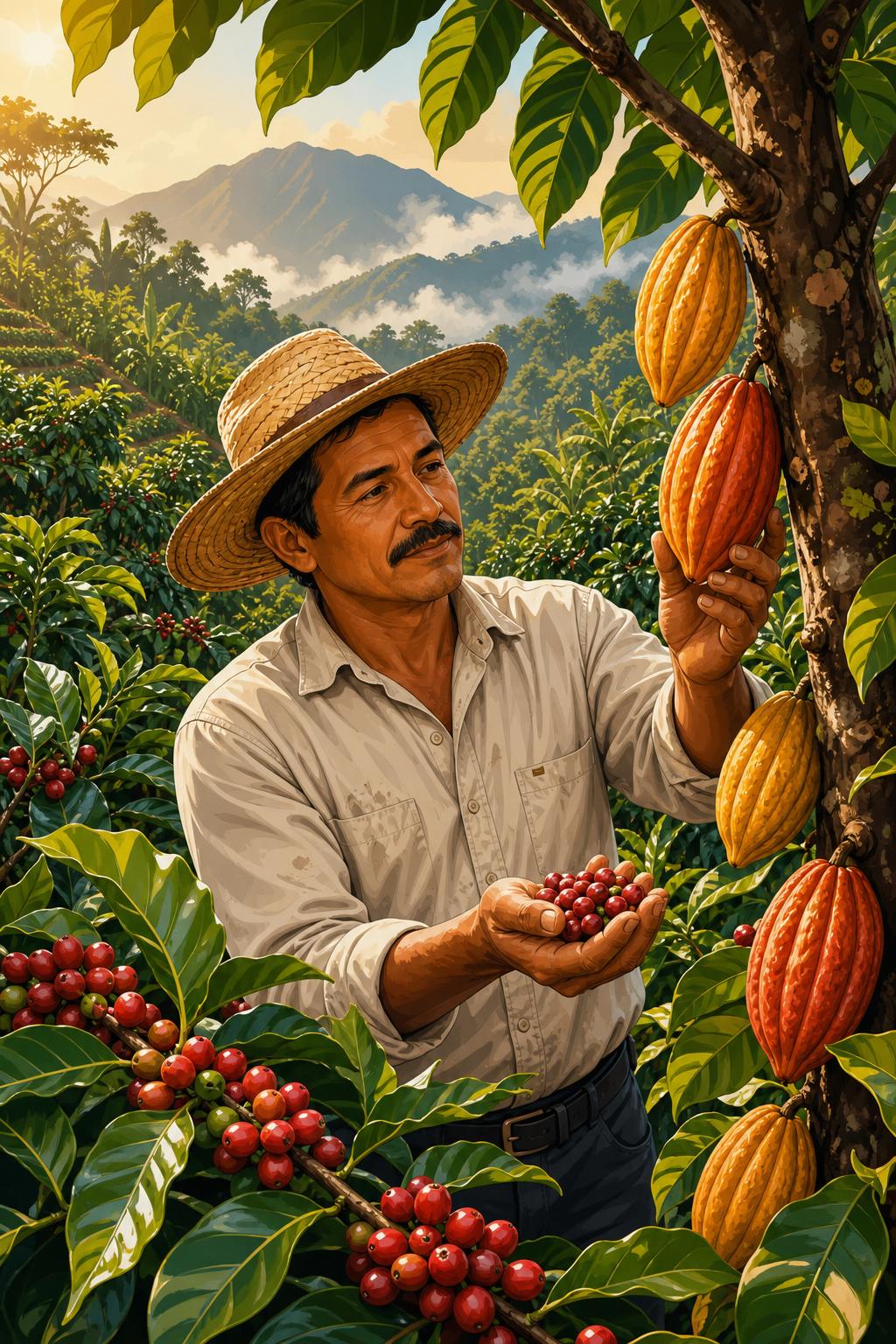
Rainforest Alliance certification has undergone a radical transformation that is redefining the rules of the game for Latin American coffee and cocoa exporters. With the full implementation of the 2020 Sustainable Certification Program (updated in 2023) and the new guidelines that took effect in January 2026, producers who do not adapt quickly risk losing access to premium markets that account for more than 40% of global trade in these products.
The Current Landscape: Numbers That Are Transforming the Industry
According to data from the Rainforest Alliance published in March 2026, there are currently 1.8 million certified producers worldwide, of which approximately 920,000 are located in Latin America. Brazil, Colombia, Peru, Ecuador, and Honduras account for 73% of regional certifications for coffee and cacao.
The market is responding strongly. A study by Fairtrade International and Cornell University (2025) revealed that Rainforest Alliance-certified coffee achieved an average price premium of $0.22 USD per pound over conventional coffee on the New York market in 2025, while certified cocoa earned a premium of $285 USD per metric ton on the European market.
Even more revealing: 68% of U.S. importers and 74% of European importers surveyed by the International Trade Centre in January 2026 stated that they will prioritize suppliers with verifiable sustainability certifications over the next 24 months. This is not a preference; it is a structural transformation of the market.
The Changes Coming in 2026 That You Need to Know About
The January 2026 update to the Rainforest Alliance program introduced stricter requirements in six critical areas that directly affect Latin American producers:
- Mandatory Digital Traceability: All certified producers must implement digital traceability systems by December 31, 2026. This means that each batch must be traceable from the farm to the point of export using approved digital platforms. For small producers, this represents a significant but not insurmountable technological challenge.
- Deforestation Due Diligence: The new “zero deforestation” requirements are aligned with the European Union Deforestation Regulation (EUDR), which also took full effect in 2026. Producers must demonstrate, using satellite geolocation, that no deforestation has occurred on their lands since December 2020. According to data from the World Resources Institute (WRI, 2026), this affects approximately 12% of current Latin American producers operating in agricultural frontier areas.
- Living Income Risk Assessment: One of the most important additions is the requirement that cooperatives and producer groups demonstrate concrete strategies to improve their members’ incomes toward a “living income.” The Global Coffee Platform estimated in 2025 that 67% of Latin American coffee farmers still do not meet this threshold.
- Climate Risk Management Systems: Producers must implement documented climate change adaptation plans, including strategies for droughts, floods, and emerging pests. The International Center for Tropical Agriculture (CIAT) reported in February 2026 that 89% of Central America’s coffee-growing regions will face altered climate conditions by 2030.
- Expanded Ban on Agrochemicals: The “red list” of banned agrochemicals was expanded to include 47 additional substances, many of which are commonly used in Latin America. This requires a transition to integrated pest management, which may take between 18 and 36 months.
- Gender and Social Inclusion Requirements: For the first time, measurable indicators for gender equity and the prevention of child labor have been established, along with more rigorous verification mechanisms. The International Labor Organization (ILO) estimates that this affects traditional practices on approximately 230,000 family farms in Latin America.
Market Opportunities for Certificates in 2026
Despite the challenges, the numbers show that certification opens up real opportunities:
- United States: The U.S. market imported $6.2 billion worth of coffee in 2025 (U.S. Department of Agriculture), of which 31% was certified sustainable coffee. Starbucks, which purchased 321,000 metric tons of coffee in 2025, announced in March 2026 that by 2027, 100% of its coffee must be certified by the Rainforest Alliance, C.A.F.E. Practices, or organic certification.
- Europe: The European market is even more demanding. Germany, which imported 1.1 million metric tons of coffee in 2025 (Coffee Sector Report, German Coffee Association), shows that 47% of its imports already hold some form of sustainability certification. The Netherlands, the main port of entry for cocoa (which processed 587,000 metric tons in 2025, according to the Cocoa Association of the Netherlands), has announced that by 2028 it will import only certified cocoa.
- Asia-Pacific: The most promising emerging market. Japan increased its imports of certified coffee by 89% between 2023 and 2025 (Japan External Trade Organization - JETRO), reaching 78,000 metric tons. South Korea saw growth of 156% during the same period.
Implementation Strategy: Practical Steps for Exporters
For Latin American exporters seeking to obtain or maintain their certification under the new rules, the path is clear but demanding:
Phase 1: Assessment and Gap Analysis (Months 1–3)
Conduct a comprehensive self-assessment against the new 2026 requirements. The Rainforest Alliance offers free self-assessment tools on its digital platform. Identify specific gaps in your operations or on your suppliers’ farms.
Pay special attention to:
- Digital traceability capabilities (Do producers have smartphones or internet access?)
- Satellite mapping of properties (precise geolocation data)
- Records of agrochemical use over the past 3 years
- Documentation of Producers' Income
Phase 2: Training and Capacity Building (Months 3–8)
Training is the most common bottleneck. According to the Inter-American Institute for Cooperation on Agriculture (IICA, 2025), cooperatives that invest at least $45 USD per producer in training specifically related to certification have an 87% success rate, compared to 34% for those that do not.
Critical areas for training:
- Use of mobile traceability apps
- Integrated Pest Management Without Prohibited Agrochemicals
- Recording and Documenting Internships
- Understanding Deforestation and Mapping Requirements
Phase 3: Investment in Infrastructure (Months 6–12)
Estimated necessary investments. Data from the Inter-American Development Bank (IDB, 2025) indicate that the average cost of initial certification for a group of 100 small Latin American producers is $18,000–$32,000 USD, broken down as follows:
- Initial audit and certification fees: $3,500–$6,000
- Digital traceability systems: $4,000–$8,000
- Training: $4,500–$7,000
- Infrastructure improvements (storage, signage): $3,000–$6,000
- External technical assistance: $3,000–$5,000
However, the return on investment is verifiable. A longitudinal study by CLAC (Latin American and Caribbean Coordination of Small Fair Trade Producers, 2025) tracked 340 cooperatives over three years and found that those certified by the Rainforest Alliance experienced an average 23% increase in net income during the second and third years following certification.
Phase 4: Audit and Certification (Months 12–15)
The certification audit under the new 2026 standards is more comprehensive. It includes: